Can You Receive Holy Communion Without Confession? Essential Church Guidelines
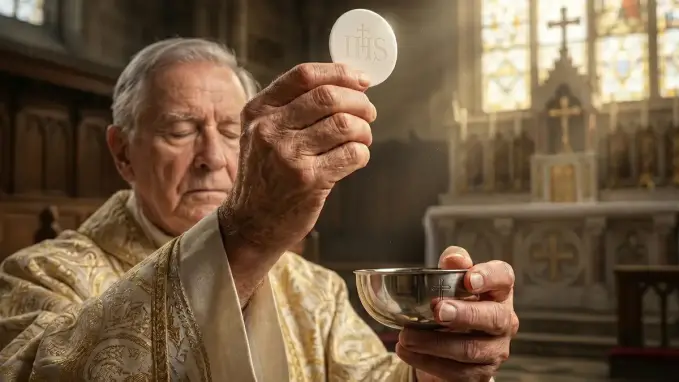
Receiving Holy Communion without confession can be dangerous. Discover the essential requirements to receive Jesus worthily and protect your soul today. Pray now!
Are you unknowingly putting your soul at risk every time you join the communion line? Receiving Holy Communion without confession has become a casual habit for many, but in the eyes of eternity, it is a spiritual danger of the highest magnitude. The Eucharist is not a social ritual or a simple piece of bread; it is the living Body of Christ that demands a temple—your soul—to be in a state of grace. If you have been approaching the altar without prior sacramental confession, you might be blocking the very graces you seek. Discover why confessing your sins is the non-negotiable key to a worthy reception of the Lord and how to avoid the "spiritual ruin" that comes from a lack of preparation.
Receiving Holy Communion without confession seems to be a habit for many today, but one must be extremely careful because this is very dangerous for your spiritual life. Sacramental confession is a prerequisite to receiving the Lord in a state of grace, ensuring that the soul is a fitting dwelling place for the King of Kings.
Participating in Holy Communion is to share in and remember your covenant with God—the pact made possible by the supreme sacrifice of Christ on Calvary.
What is Holy Communion?
The Holy Eucharist is the most important of the seven sacraments because, in this sacrament and no other, we receive the actual Body and Blood, Soul and Divinity of Jesus Christ. It is the "Source and Summit" of the Christian life.
Innumerable and precious graces flow to us through the worthy reception of Holy Communion. However, by receiving communion without confession when in a state of mortal sin, we not only distance ourselves from these graces but also place our spiritual condition in a terrible state. To receive the Holy One while harboring grave sin is a contradiction that wounds the heart of the Church.
Holy Communion is an intimate encounter with Christ, where we sacramentally receive Him into our bodies so that we may be more completely assimilated into His Mystical Body. "The Eucharist builds the Church," as Saint John Paul II said (Redemptor Hominis 20). It deepens our unity with the Church, as it assimilates us more fully to Christ. To receive communion without confession is to attempt to welcome Christ into a stained soul, refusing the very purification He offers in the confessional.
Christ in the Eucharist strengthens the individual because in it, Jesus Himself—the Word made flesh—gives us the supernatural strength to resist mortal sin. It is also the very channel of eternal life: Jesus Himself, our Bread of Life.
The Danger of Communion Without Confession
The Catholic Church establishes specific guidelines regarding how we must prepare ourselves to receive the Body and Blood of the Lord in Communion. It clearly indicates that receiving communion without confession, when one is aware of grave sin, is fundamentally wrong and spiritually harmful.
1. Being in a State of Grace
"Therefore whoever eats the bread or drinks the cup of the Lord in an unworthy manner will be guilty of profaning the body and blood of the Lord. Let a person examine himself, and so eat of the bread and drink of the cup" (1 Cor. 11:27-28).
Reflection: St. Paul"s warning is a pillar of our faith. To "examine oneself" means to look into the mirror of the Ten Commandments and see if our soul reflects the light of God or the darkness of sin. Do not take this lightly; your eternity depends on this self-examination.
This is an absolute requirement that can never be dispensed. Receiving the Eucharist without sanctifying grace in your soul profanes the Eucharist in the most painful way. A mortal sin is any sin whose matter is grave and which has been committed voluntarily and with full knowledge of its gravity. Grave matter includes, but is not limited to: murder, participating in an abortion, homosexual acts, sexual relations outside of marriage or in an invalid marriage, and deliberately indulging in impure thoughts (Mat. 5:28-29). Receiving communion without confession after committing these sins brings spiritual ruin.
The Scriptures contain clear lists of mortal sins (e.g., 1 Corinthians 6:9-10 and Galatians 5:19-21). For more information on what constitutes a mortal sin, consult the Catechism of the Catholic Church.
2. Confessing Since Your Last Mortal Sin
"But first confess your transgressions, that your sacrifice may be pure" (Didache 14).
Reflection: Even the earliest Christians understood that purity of heart was the only way to approach the altar. The Didache, the teaching of the twelve apostles, reminds us that the "Sacrifice" of the Mass requires a "Pure" recipient.
The 1983 Code of Canon Law indicates that the same requirement applies today:
"A person who is conscious of grave sin is not to... receive the body of the Lord without previous sacramental confession unless there is a grave reason and there is no opportunity to confess; in this case, the person is to be mindful of the obligation to make an act of perfect contrition, including the intention of confessing as soon as possible" (CIC 916).
The requirement of sacramental confession can only be dispensed if four conditions are met simultaneously:
- There must be a grave reason to receive Communion (e.g., danger of death).
- It must be physically or morally impossible to confess first.
- The person must already be in a state of grace through an act of perfect contrition (sorrow for sin based on the love of God).
- The person must resolve to confess as soon as possible.
To Receive Communion, One Must Confess
In this digital age, we bring you vital observations to consider before approaching the altar. Any attentive observer of liturgical celebrations will have noted a widespread phenomenon that is becoming dangerously "normal":
- The number of faithful accessing the Sacrament of Penance has decreased alarmingly.
- The number of faithful receiving communion without confession has increased considerably.
- Many sacramental celebrations (baptisms, weddings, funerals) have become mere social events for many attendees, lacking spiritual depth.
The teaching of the Church, grounded in the Word of God, has remained constant throughout the centuries. It has always taught that to receive communion, one must be in the grace of God, without grave sin on the conscience, and observe the required fast. Receiving communion without confession is a terrible disservice to your soul.
In the beautiful encyclical of Pope Saint John Paul II on the Church and the Eucharist (Ecclesia de Eucharistia, no. 36), the Pope made clear the official teaching of the Church as set forth in the Catechism and the Code of Canon Law. He reaffirmed the validity of the Decree of the Council of Trent, specifying St. Paul’s severe exhortation: for a worthy reception of the Eucharist, "the confession of sins must precede, when one is conscious of mortal sin."
Do Not Trivialise the Holy Eucharist
It is not an exaggeration to state that many of those who approach communion do not meet the necessary conditions to do so—whether out of ignorance, lack of faith, routine, or simply "following the crowd." This bad practice of receiving communion without confession is leading to a trivialization of the principal sacrament of the Church and a distortion of the conscience of many baptized persons.
Ordained ministers—bishops and priests—who preside over these celebrations bear a great responsibility to guide the faithful. In the absence of adequate prior catechesis, a respectful warning to those present before distributing communion would be highly appropriate. One might say: "There is no obligation to receive communion... Let those who intend to do so examine their conscience before God and see if they are in His holy grace." Raising awareness of this phenomenon is urgent, grave, and of the highest responsibility.
Communicating and Giving Thanks
After receiving Communion, it is deeply appropriate to remain after Mass and thank Jesus for coming into your heart in the Holy Eucharist. The Church encourages this practice:
"The faithful are recommended not to omit giving thanks after Communion. They may do this during the celebration with a period of silence, with a hymn, psalm, or other song of praise, or also after the celebration, if possible staying behind to pray for a suitable time" (Inaestimabile Donum 17).
Reflection: Imagine receiving the King of the Universe into your very being and then rushing out the door as soon as you swallow. Does your Guest not deserve a few minutes of your undivided attention? Silence is the language of love.
After receiving Jesus in His totality and internalizing Him into your own life, how could you not offer thanks? Never fall into the harmful habit of receiving communion without confession. Treat every Communion as if it were your first, your last, and your only one.
Protect Your Soul and the Sanctity of the Altar!
The Eucharist is the pearl of great price, but to receive it unworthily is to wound the Heart of Christ. If this article has opened your eyes to the gravity of sacramental preparation, do not allow your brothers and sisters to continue in ignorance. Your knowledge is now a mission.
Be a guardian of the Eucharist! Share this truth today.
Click the share buttons and help others rediscover the beauty of a pure heart through Confession. Let us return to the altar with the reverence our Lord deserves. Type "AMEN" in the comments if you commit to receiving Jesus worthily!
❓ FAQ: Frequently Asked Questions: Communion and Confession
Receiving the Eucharist while conscious of mortal sin is spiritually dangerous and constitutes a profanation of the Sacrament. The Church teaches that a state of grace is a non-negotiable requirement for a worthy reception. To avoid spiritual ruin and respect the Body of Christ, you must seek sacramental confession to restore your soul's purity before approaching the altar.
Being in a state of grace means your soul is free from mortal sin and remains a fitting dwelling place for God. It requires a sincere self-examination against the Ten Commandments. If you harbor grave transgressions, you are spiritually blocked from the graces of the Eucharist. Only through the Sacrament of Penance can this vital, sanctifying life be fully restored.
Private contrition is beautiful, but the 1983 Code of Canon Law mandates sacramental confession for those conscious of grave sin before receiving Communion. Except in extreme circumstances like the danger of death, an act of perfect contrition must always include the firm intention to confess to a priest as soon as possible to ensure a valid, worthy reception.
Receiving unworthily trivializes the Source and Summit of Christian life, turning a divine encounter into a social ritual. St. Paul warns that doing so makes one "guilty of profaning the body and blood of the Lord." Instead of receiving supernatural strength, a soul in grave sin wounds the Heart of the Church and risks its own eternal well-being.
If you cannot access the Sacrament of Penance and are aware of grave sin, the most reverent act is to refrain from receiving Communion. You may make a Spiritual Communion from the pew, asking Jesus to enter your heart desire. This humble discipline honors the sanctity of the Eucharist while you prepare your soul for a future, fruitful sacramental confession.
 Venezuelan, faithful husband and father of a family. Electronic engineer and missionary of the faith. Committed to the proclamation of the Gospel. Solid believer that there are always new beginnings. Whoever has God has nothing to stop him.
Comments
Want to leave comments or also intentions on our homepage?
Register nowBe the first to comment.
Useful Resources
Walking in Faith

Discover how to protect your mental and spiritual health with these effective Catholic strategies to prevent depression, leaning entirely on God's daily grace
Walking in Faith
Whoever receives the Brown Scapular commits to the Carmelite spirituality. Discover nine essential things you need to know about this powerful sacramental
Walking in Faith

Spiritual therapy offers a profound path to heal depression: Discover three essential Catholic steps to restore your mental health and find lasting peace today
Walking in Faith
Experience the miraculous healing anointing of the Sacred Heart of Jesus through this prayer: Discover how His infinite mercy can heal and transform your life.
Walking in Faith

Discover the 12 promises of the Sacred Heart of Jesus: Learn how these divine blessings of mercy, love, and protection can transform your family and life today
Walking in Faith