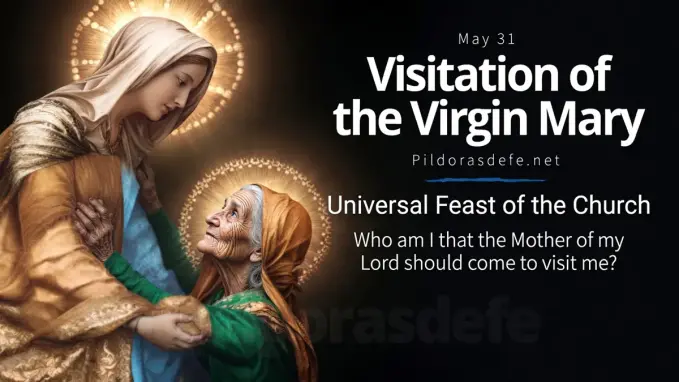
The beautiful Feast of the Visitation of the Blessed Virgin Mary celebrates the glorious encounter of Jesus and Saint John the Baptist in the womb. Read more
Are you seeking a profound spiritual awakening that can instantly shatter the cold walls of isolation and fill your soul with absolute, radiant joy? Step directly into the breathtaking mystery of the Feast of the Visitation of the Blessed Virgin Mary, a glorious universal celebration where heaven and earth beautifully collide in a hidden embrace of radical love. This magnificent biblical encounter is far more than a simple historical journey; it represents the ultimate convergence of prophetic fulfillment as the unborn John the Baptist leaps in ecstatic adoration inside the womb of Saint Elizabeth upon hearing the grace-filled greeting of Mary. Discover how this majestic feast day invites you to experience a personal visitation of the Holy Spirit, igniting an unshakeable fire of charity today.
Feast: May 31
The historical and spiritual visit of Mary to her cousin Elizabeth took place precisely when Elizabeth was already six months pregnant with the glorious precursor of Christ, Saint John the Baptist.
History of the Visitation of the Blessed Virgin Mary
During the majestic Annunciation of the Lord, Saint Gabriel the Archangel, in direct response to Mary's humble question: "How can this be, since I have no relations with a man?" (Luke 1:34), had specifically told her: "And behold, Elizabeth, your relative, has also conceived a son in her old age, and this is the sixth month for her who was called barren; for nothing will be impossible for God" (Luke 1:36-37).
Saint Luke beautifully records that Mary immediately undertook the long, arduous, and highly dangerous journey from Nazareth to a town in the hill country of Judea upon learning from the words of the Angel that her cousin Elizabeth was pregnant. She was completely clear about her sacred mission of charity, and she absolutely did not allow anyone or anything to delay her footsteps.
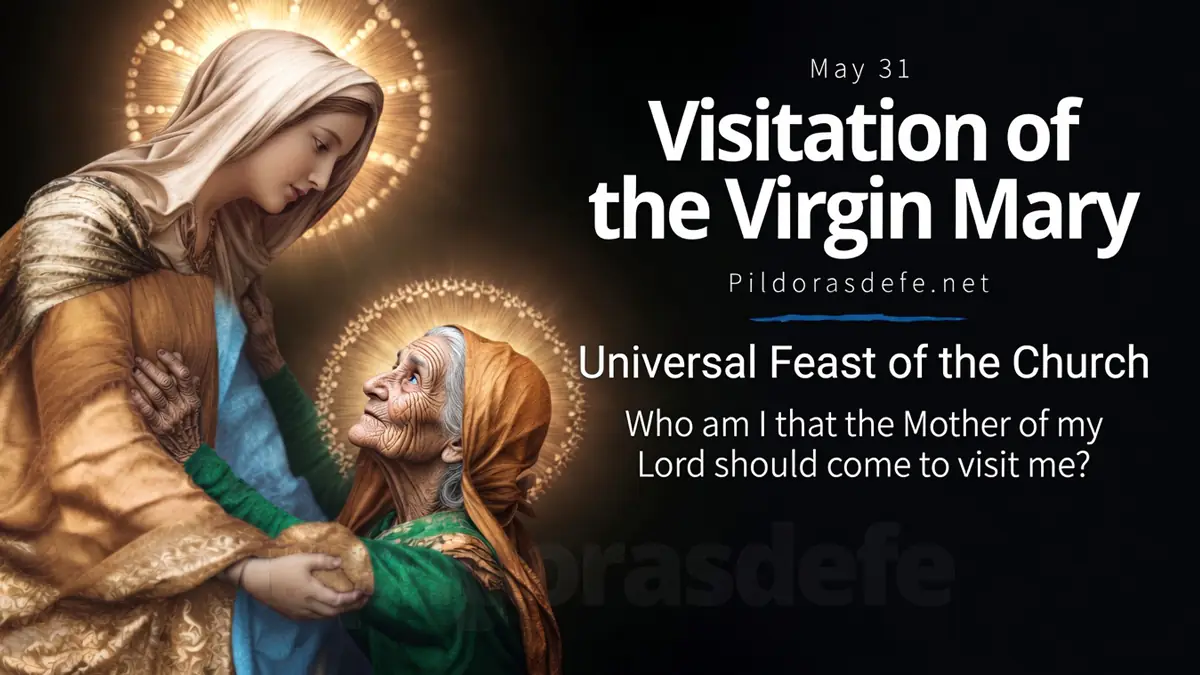
Deep analysis of the Visitation
There are two essential spiritual aspects that we clearly observe in the sacred scene of the Visitation of the Virgin Mary that we must carefully consider today.
1. The Personal Agenda of Mary and Elizabeth
Any pending matter on the personal agendas of Mary and Elizabeth was completely cast aside. Both holy women had excellent human reasons to be deeply preoccupied with their respective pregnancies and everything that accompanies bringing a brand-new life into the world.
Both had every right to focus entirely on themselves for a time. Yet, Mary visits her cousin Elizabeth to selflessly help her and, simultaneously, to be profoundly helped and validated by her prophetic words.
These two extraordinary women deeply consoled one another, shared their miraculous stories, and gave each other the sublime gift of mutual support in the midst of the new life they were experiencing: Elizabeth, after her lengthy, painful years of barrenness and now her sudden pregnancy, and Mary, after her staggering encounter with the heavenly messenger, navigating an irregular marital situation alongside her divine pregnancy.
2. The Haste of the Virgin Mary
In his profound commentary on the Gospel of Luke, Saint Ambrose of Milan describes this holy haste of Mary with a famous Latin phrase: "nescit tarda molimina Spiritus Sancti gratia," which masterfully means: "the grace of the Holy Spirit knows no delayed efforts."
The promptness of the Mother of God reveals a soul entirely submissive to the movements of grace. The Catechism teaches that Mary is the perfect icon of faith because she believes that nothing is impossible with God (CCC 273). Her haste is not a sign of human anxiety, but rather the natural velocity of a heart consumed by charity.
Mary's free choice to advance forward and outward is the radiant reflection of a decision made in the absolute depths of her immaculate heart, immediately followed by decisive, loving action.
How many good things are there in our lives that we have dreamed of doing, that we should have done, but never actually accomplished? Letters we should have written, holy dreams we should have fulfilled, gratitude we ought to have expressed, or affection we never showed? Procrastinating and delaying our acts of charity weighs heavily upon our souls, wearing us down and discouraging our spirit.
Transcendental Teachings of the Visitation
The historical narrative of Mary's visit to Elizabeth teaches us a vital lesson: when Christ is actively growing within us, we will be interiorly compelled toward people, places, and situations we never dreamed of. We will find ourselves speaking words of comfort and supernatural hope that are absolutely not our own. In the very act of consoling others, our own hearts will be deeply consoled.
We will abide in perfect peace and recollection, because we know that no matter how insignificant our daily lives and trials may appear to the world, Christ is being dynamically formed within us through them.
The holy women of today's Gospel beautifully demonstrate that it is entirely possible to go far beyond our own small, selfish personal agendas and participate in the authentic ministry of selfless service—the true ministry of divine love.
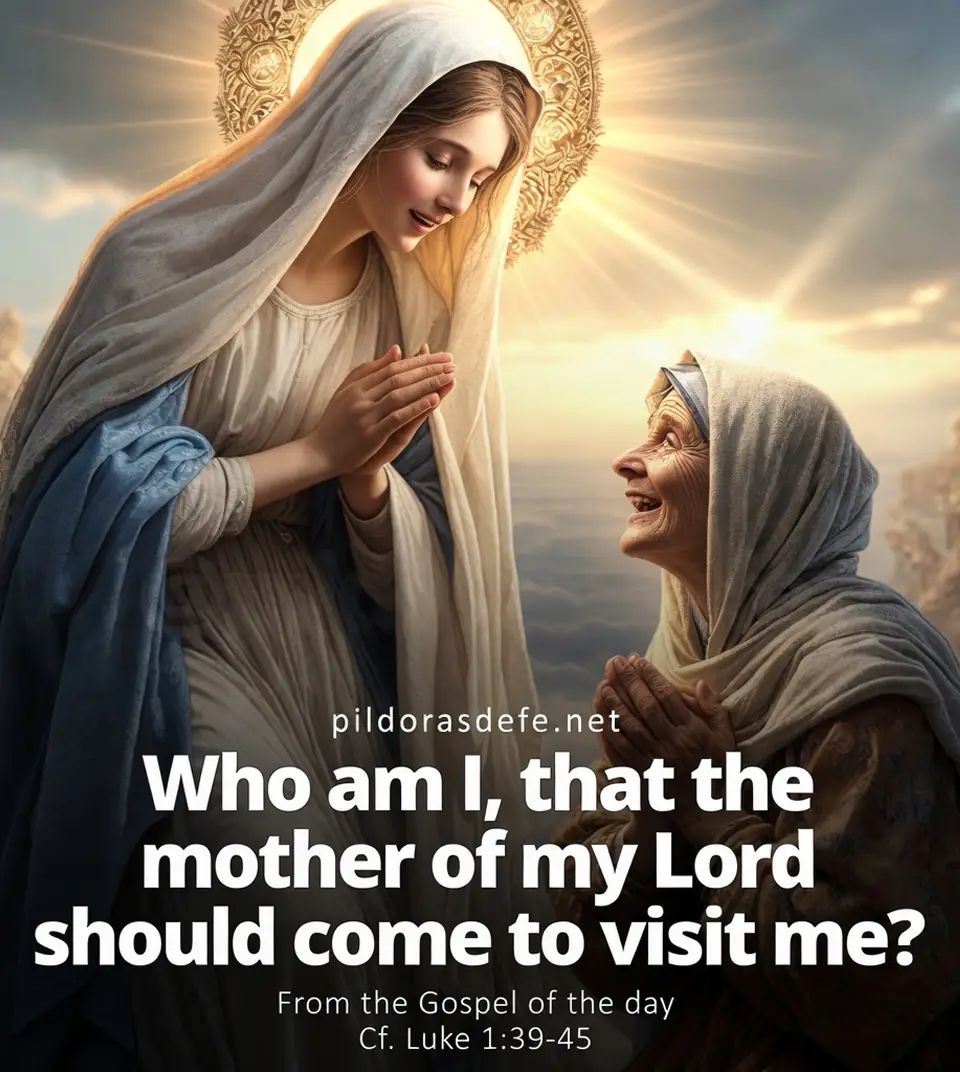
Mary's Visitation Radiates Peace, Joy, and Salvation
The physical presence of Our Lord Jesus Christ within the virginal womb of Mary radiates an immensely powerful force capable of sanctifying everyone who encounters Him. This reality is manifested in the inspired words and gestures of faith that erupt from Saint Elizabeth and her unborn child, John the Baptist.
The moment the Virgin Mary enters the house and greets her relative, John the Baptist instantly leaps for joy inside Elizabeth's womb. Filled with the Holy Spirit through that grace-filled greeting, Saint Elizabeth exclaims those profound words that countless generations will pray for all eternity, in every language under heaven: "Blessed are you among women, and blessed is the fruit of your womb." The Visitation of the Virgin Mary stands eternally as one of the scriptural sources of the Hail Mary prayer.
In this exact moment, Saint Elizabeth becomes a true prophet of the New Covenant. Her words, flowing directly from the inspiration of the Holy Spirit, remain unshakeably true for all eternity.
The Visitation of Mary and the Magnificat
It was during the Visitation when the Blessed Virgin Mary recited her monumental prayer, the Magnificat, which would remain recorded for all eternity. Today, the Magnificat has become the ultimate song of praise and adoration to Almighty God.
Countless religious and laypeople across the globe find daily comfort and supernatural peace in these words, making them a core part of their daily devotion by reciting them every single evening during the Liturgy of the Hours.
The Magnificat, or Canticle of Mary
We find this beautiful prayer elegantly recorded in the first chapter of the Gospel of Luke. The exact text of the Magnificat is presented below:
"My soul proclaims the greatness of the Lord; my spirit rejoices in God my savior. For he has looked upon his handmaid’s lowliness; behold, from now on will all generations call me blessed. The Mighty One has done great things for me, and holy is his name. His mercy is from age to age to those who fear him. He has shown might with his arm, dispersed the arrogant of mind and heart. He has thrown down the rulers from their thrones but lifted up the lowly. The hungry he has filled with good things; the rich he has sent away empty. He has helped Israel his servant, remembering his mercy, according to his promise to our fathers, to Abraham and to his descendants forever."
The Authentic Charity of Mary
Mary's journey to visit her cousin Elizabeth demonstrates our universal call to live in deep Christian community. At times, our physical presence is the single greatest gift we can offer to another lonely soul. It reminds us that Mary carries Christ within her during her pilgrimage, giving a profound theological meaning to her decision to offer support.
The holy Pope Saint John Paul II recognized this during a historic homily in 1997, reflecting on the Visitation: "In this act of human solidarity, Mary demonstrated that authentic charity grows exponentially within us whenever Christ is actively present."
In our passing earthly lives, we must continuously practice this ministry: doing things for others, loving difficult people, serving the poor, allowing ourselves to serve and be served, comforting the brokenhearted, and loving without schedules or human limitations.
Such moments completely free us from our own suffocating egoism and allow us to sing the Magnificat with real joy alongside Mary throughout our lives, celebrating the marvelous things God accomplishes for His people. Holy Mary, pray for us.
The Visit of Mary to All of Humanity
Saint Luke the Evangelist provides sufficient details of Mary's life to appreciate how a true disciple of Christ must live. Surely, many precious things were left unwritten. We remember the words of the Apóstol Saint John at the end of his Gospel, stating that Jesus did many other things that are not recorded in writing.
The exact same can be said of our Blessed Mother. Countless holy words were spoken, gentle gestures made, and miraculous events produced that remain unrecorded mysteries. However, if we knew absolutely everything about the hidden things of God, heaven would no longer be a breathtaking surprise for us.
Mary is truly blessed among women, and her divine Fruit has changed human history forever. Her humility prompts her to instinctively deflect praise, pointing directly to the source of all goodness: God. Mary leads the way in clearing the tangled path grown from the sin of Eve. With humanity close to her maternal heart, she guides us to rediscover the source of all truth, goodness, and beauty.
4 Fascinating Facts About the Sacred Visitation
1. The Ark of the New Covenant
The journey of Mary to the hill country of Judea perfectly mirrors King David bringing the Ark of the Covenant to the exact same region (2 Samuel 6). Just as David danced and leaped before the Ark, asking, "How can the ark of the Lord come to me?", Elizabeth exclaims, "And how does this happen to me, that the mother of my Lord should come to me?"
2. The First Eucharistic Procession
The Visitation is teologically recognized as the very first Eucharistic procession in human history. Mary acts as the living Tabernacle, carrying the physical Body of Jesus Christ across the mountains of Israel, radiating sanctification and joy to those she encounters along the way.
3. The Three-Month Mystery
Saint Luke specifically notes that Mary stayed with Elizabeth for exactly three months. This details an intentional scriptural link to the Old Testament, where the ancient Ark of the Lord remained in the house of Obed-edom the Gittite for precisely three months, bringing immense divine blessings to his entire household.
4. The Sanctification of the Precursor
Catholic tradition teaches that when John the Baptist leaped for joy in the womb, he was cleansed from original sin. This fulfills the angel's prophecy to Zechariah that John would be filled with the Holy Spirit even from his mother's womb, making the Visitation the moment of John's prenatal baptism of grace.
The Lesson of Selfless Christian Service
The Visitation provides a luminous blueprint for true Catholic stewardship and communal love. As the Gospel reveals, our faith becomes dead without active charity. When we courageously look past our personal trials to comfort those in need, we allow Christ to manifest through our actions.
Let us mirror Mary's promptness, ensuring that our daily choices continuously magnify the Lord and bring His real presence to a fractured world.
Miraculous Prayer to the Blessed Mother of Joy
O Holy Virgin Mary, beautiful Mother of God, we humbly implore your powerful intercession today. Just as you journeyed to the hill country with haste to serve your cousin Saint Elizabeth, grant our hearts the strength to run toward those who suffer in silence.
Fill our homes with the active presence of the Holy Spirit, so that like Saint John the Baptist, our spirits may leap with profound joy at your heavenly greeting.
Remove all trace of selfishness from our souls, teach us to embrace the humility of your Magnificat, and lead us safely into an intimate, everlasting encounter with your Divine Son, Jesus Christ. Amen.
Open Your Door to Divine Grace Today
Do not permit your daily burdens to paralyze your capacity for radical Christian service.
Fiercely welcome the visitation of the Blessed Mother into your home right now! Allow her maternal protection to purify your intentions and completely fill your household with the unshakeable fire of the Holy Spirit.
Will you courageously step out of your personal comfort zone to carry the radiant light of Christ to a brother who is currently walking in deep darkness? The beautiful example of Mary shows us that true joy multiplies only when it is shared through selfless love. Begin your journey of active charity this very hour!
❓ FAQ: Frequently Asked Questions About the Visitation of Mary
The Visitation signifies the profound mystery of the first Eucharistic procession, where Mary carries the unborn Christ to sanctify Saint John the Baptist. It beautifully models how genuine Christian love always prompts us to serve others immediately. As the Gospel declares, Mary traveled "with haste" (Luke 1:39), demonstrating that true charity never delays in bringing Jesus to humanity.
Saint John leaped because he instantly recognized the presence of the Messiah hidden within Mary's virginal womb. This miraculous event represents the prophetic cleansing of the Precursor by the Holy Spirit before his actual birth. The Catechism affirms that John was "filled with the Holy Spirit even from his mother's womb" (CCC 717) through Mary's maternal voice.
The Magnificat is the sublime song of praise extemporaneously recited by the Blessed Virgin Mary during her encounter with Saint Elizabeth. Recorded fully in the Gospel of Luke, this majestic hymn perfectly encapsulates her deep humility, her absolute gratitude, and her radical trust in God's promises. It remains a daily pillar of the Church's evening Liturgy of the Hours.
The Visitation provides the foundational scriptural text for the second part of the first half of the Hail Mary. When Saint Elizabeth proclaims under the inspiration of the Holy Spirit, "Blessed are you among women, and blessed is the fruit of your womb" (Luke 1:42), she establishes the eternal liturgical praise that millions of Catholics recite daily.
The Catholic Church universally celebrates this beautiful feast day on May 31. This strategic liturgical placement sits perfectly between the Solemnity of the Annunciation on March 25 and the Nativity of Saint John the Baptist on June 24. It invites all faithful to deeply contemplate the visitation of grace before celebrating the regular months of Ordinary Time.
Another Daily Saints.

 Venezuelan, faithful husband and father of a family. Electronic engineer and missionary of the faith. Committed to the proclamation of the Gospel. Solid believer that there are always new beginnings. Whoever has God has nothing to stop him.
Useful Resources
Papa Francisco
The Vatican has released the calendar of the celebrations from Pope Francis for Holy Week and Easter 2021, following coronavirus covid-19 restrictions.
Papa Francisco
Of the devotion to Sleeping St. Joseph, Pope Francis said that this saint did not imagine that he was caring for the life of a nascent Church.
Iglesia

The Church has no power to bless same-sex unions. They cannot be considered licit, according to the Congregation for the Doctrine of the Faith.
Papa Francisco
Pope Francis: The world is changed by the beatitudes, not by power or force. Homily of Pope Francis at Saint Joseph Cathedral in Baghdad.
Papa Francisco
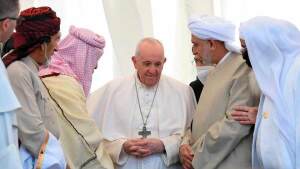
Pope Francis: The path to peace begins with the decision not to have enemies. It means spending less money on weapons and more on food, education, education,
Papa Francisco
Pope Francis: For Lent, one should read the Gospel and include a different kind of fasting: fasting from gossip and spreading rumors or backbiting.
Papa Francisco
Pope Francis: The Lord has given us an effective vaccine against this unpleasant virus. It is hope... With this vaccine, we can emerge with renewed strength.
Papa Francisco