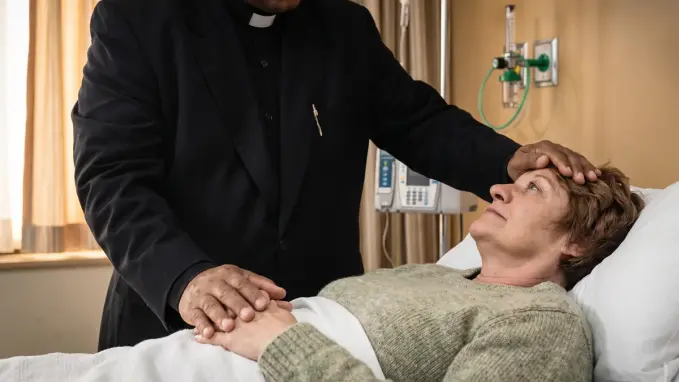
Facing death, the soul sees the truth. Discover the 21 deep regrets and secrets people confess before dying to find final peace and God's mercy. Read more now!
Is it possible to wait until the very last second of your life to settle your accounts with God and still achieve the same eternal salvation as a lifelong saint? The question of deathbed confessions is one that haunts the human heart: can mercy truly reach someone at the edge of the abyss? While some may find it unfair that a lifetime of wandering can be redeemed in a single breath of repentance, the reality of God"s love defies human logic. Discover the 21 most common things people confess before dying and learn how these final revelations are not just regrets, but a desperate cry for the mercy that transforms a "lost life" into a "saved soul." Do not wait until your final hour to understand what truly matters; the truth of eternity is calling you today.
Can a person confess their errors and truly repent in the final moments of their life? When facing death and the imminence of the beyond, can they achieve the same salvation as someone who has practiced the faith for decades? The answer is a resounding YES!
This is a difficult yet fascinating question. We are talking about having faith and confessing at the edge of the cliff, in those desperate and crisis-filled moments when people lament their choices and finally decide to stop postponing their surrender to God. Many people argue that it makes no sense for a lifelong Christian to be in the same state as someone who lived purely for their own desires and only sought God at their last gasping breath. However, we must remember that God’s measure is not our own; His mercy is an unfathomable ocean that does not follow human arithmetic.
Let us remember Saint Dismas, the Good Thief. While hanging on a cross, he confessed his sins before Jesus and was immediately promised Paradise. We also have the Parable of the Workers in the Vineyard, where God pays the same wage to the one who arrived at the last hour as to the one who worked all day. This teaches us the ultimate lesson: "The last shall be first, and the first shall be last."
Nevertheless, I am not suggesting that those who intentionally delay their reconciliation with God are guaranteed salvation. Many claim they will dedicate time to God in their old age, but they do not know what destiny holds and often leave this world without settling their spiritual accounts. I would not want to be in those shoes. True wisdom is living every day as if it were your last confession.
The 21 Most Common Deathbed Confessions
Having explained the power of late repentance, let us look at the most frequent confessions shared by those at the threshold of eternity, as compiled by Father Nelson Medina:
- Setting a bad example: The realization that my actions led others to stray from the path of light.
- Indifference to pain: Those moments when I saw someone suffering and simply walked away.
- Causing harm: The weight of the people I hurt, physically or emotionally, throughout my journey.
- Foolish words: All the vulgar, harsh, or aggressive things that ever escaped my lips.
- Broken promises: The pain of knowing my word was not always my bond.
- Vain materialism: All the things I bought that I never truly needed or even used.
- Delayed forgiveness: The immense time and effort I wasted before finally deciding to forgive.
- Lack of prayer: The many times I could have spoken to God but chose silence or distractions instead.
- Failed education: Not correcting or guiding those I was responsible for teaching better.
- Silenced praise: Keeping back words of encouragement or recognition for those who deserved them.
- Fleeing the Cross: Trying to avoid the necessary sacrifices that lead to spiritual growth.
- The loneliness of Christ: Regretting the times I left Jesus alone in the Tabernacle.
- Constant complaining: Grumbling far more than I ever expressed genuine gratitude.
- Arrogance in success: Taking all the credit for my triumphs while blaming others for my failures.
- Mocking the sacred: Being a silent accomplice to jokes against God, the Faith, or the Church.
- Lost time: The devastating realization of hours wasted that can never be recovered.
- Disturbing innocence: Having blocked someone’s dreams or corrupted their purity.
- Manipulating love: Taking advantage of someone’s affection for my own personal gain.
- Enjoying flattery: Feeding my ego with praise I knew was insincere or false.
- Neglecting the "uninteresting": Failing to visit or help those I deemed beneath my social status.
- A lack of love: The final realization that I failed to love God and my neighbor as much as I should have.
We must remain vigilant over our lives. How we live, what we do, whom we comfort, and whom we wound will echo in eternity. Our actions always have consequences, whether for good or for ill. Do not wait for the darkness to seek the Light.
Do Not Leave Your Peace for the Last Minute!
Today is the day to settle your accounts. If these deathbed confessions have stirred your soul, it is because God is inviting you to a "life-bed" conversion. Do not let others die in spiritual debt. Share this profound truth now and help a friend or loved one find the mercy they need before time runs out.
Be a messenger of mercy! Share this article today.
Click the share buttons and help others rediscover the power of a pure heart. May you live with such love that your final confession is one of joy and not of regret. Type "AMEN" in the comments to commit to a life of love!
These deathbed confessions serve as a mirror for the living. They remind us that the only currency that matters in the end is the love we gave and the mercy we received. Live today so that your final "Amen" is a celebration of a life well-lived in the grace of God.
❓ Frequently Asked Questions (FAQ) about Things People Confess Before Dying
According to Catholic theology, a sincere deathbed confession is completely valid. God’s mercy is infinite and transcends human time. If the person has true contrition, they receive the same grace of salvation as any other believer. However, the Church encourages a life of faith to avoid the risk of sudden death without the opportunity to repent.
Most common regrets involve a lack of love, the weight of pride, and the realization of wasted time. People often confess neglecting their relationship with God and failing to be kinder to their neighbors. These final moments reveal that worldly triumphs matter far less than the spiritual footprints of love and service we leave behind in others.
Yes. If a person is conscious but unable to speak, an act of "perfect contrition" (sorrow for sins out of love for God) is sufficient for salvation. The Lord looks at the heart’s intent. In such cases, the Church offers the Apostolic Pardon and the Sacrament of the Anointing of the Sick to provide final spiritual strength and peace.
Facing the imminence of the end strips away the masks of pride and fear of social judgment. People feel a desperate need for "spiritual light" and to be heard by the Divine Mercy. The clarity of the soul's truth becomes unavoidable, pushing the individual to seek reconciliation and the peace that only a sincere confession can provide.
The best way to avoid deathbed regrets is to live a "Eucharistic life" today. This means practicing frequent confession, daily prayer, and active charity. By settling your accounts with God and your neighbor every night, you ensure that when the final moment comes, you are not burdened by secrets, but filled with the peace of Christ.
 Venezuelan, faithful husband and father of a family. Electronic engineer and missionary of the faith. Committed to the proclamation of the Gospel. Solid believer that there are always new beginnings. Whoever has God has nothing to stop him.
Useful Resources
Reflexiones

Explore a beautiful reflection on the Hail Mary prayer: Discover the profound spiritual meaning of each phrase so you can pray with absolute devotion today
Reflexiones

Discover the touching true miracle of Our Lady of Fatima for a husband who strongly refused to have more children. Above all human logic, God will always reign
Reflexiones
Does it hurt to say I cannot receive communion? Discover a moving testimony of faith for the divorced and remarried who thirst for Christ in their soul today ✨
Reflexiones

Discover how to hear the Holy Spirit's voice and discern His divine inspirations. Learn to silence the world and hear what God wants to say to you today. Pray now
Reflexiones

Forgiveness is not a feeling, it is a decision that heals your heart and soul. Discover the divine path to deep peace and physical health through God. Pray now!
Reflexiones

Praying the Rosary is man´s prayer for man. Saint John Paul II had a strong devotion for the prayer of the Holy Rosary
Reflexiones

One of the greatest and most famous miracles involving St. Anthony of Padua is the miracle of preaching to a group of fish
Reflexiones