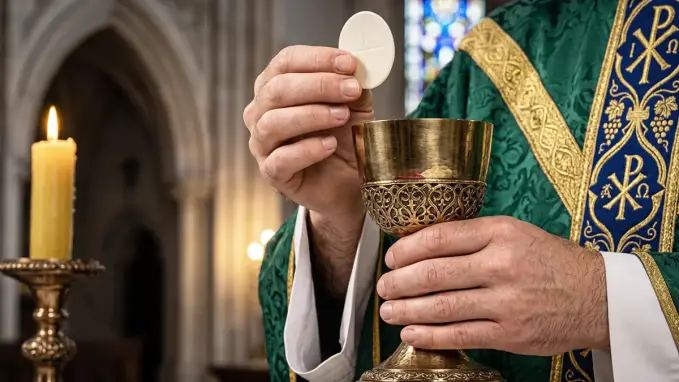
Does it hurt to say I cannot receive communion? Discover a moving testimony of faith for the divorced and remarried who thirst for Christ in their soul today ✨
Have you ever felt a profound, aching void in your soul while standing in the back of a church, watching others approach the altar while you whisper to yourself, "I cannot receive Communion"? This heavy realization is not meant to be a wall of exclusion, but rather a sacred threshold—a call to a deeper, more honest intimacy with the Divine. In our modern world, where we are told we deserve everything instantly, the act of abstaining out of reverence is perhaps the most radical form of Eucharistic love. Today, we explore how this "holy thirst" can become a powerful prayer of its own, transforming your internal struggle into a path of genuine reconciliation and spiritual peace that honors the true presence of Christ.
"I cannot receive Communion" is a phrase that some Catholics express with a deep sense of longing in their hearts. It arises when they find themselves unable to receive the graces offered through the Sacrament of the Altar due to certain requirements that God Himself, in His infinite wisdom, has established for us to draw near to Him in truth. This restraint is not a punishment, but a safeguard for the soul.
Through the Holy Spirit speaking in Saint Paul, God has willed to show us yet another work of His mercy: the correct way to approach the table of the Lord. He warns us with fatherly concern:
"Everyone ought to examine themselves before they eat of the bread and drink from the cup. For those who eat and drink without discerning the body of Christ eat and drink judgment on themselves." (1 Corinthians 11:28-29)
When someone dares to say, "I cannot receive Communion," it is because they have either correctly discerned the law of the Lord and know that their current state of life or unconfessed sins prevents it, or because they mistakenly believe it is merely a rigid rule imposed by the Church. In reality, it is an act of spiritual maturity—a recognition that the King of Kings deserves a throne prepared with a clean conscience.
Why Can’t I Receive Communion?
The answer is often straightforward: one might be immersed in a grave sin and has not yet sought the Lord"s reconciliation through Confession, or perhaps one is not a practicing Catholic. This boundary exists because of the profound reality of what the Eucharist truly is.
The Church has always been luminous regarding Transubstantiation: the bread and wine literally become the Body and Blood of Our Lord Jesus Christ. While they may still retain the appearance and taste of bread and wine, their substance has truly and substantially changed. When Our Lord said at the Last Supper, "This is my body..." we take those words with absolute seriousness. we do not rely on our limited human logic; instead, we BELIEVE in the Word that Jesus spoke to us. To receive Him while denying His laws or while in a state of spiritual death is a contradiction that wounds the soul.
If someone does not believe that Christ is truly present in the Eucharist, or is in a state of mortal sin, it would be a grave act of disrespect to receive His Body and Blood. Therefore, saying "I cannot receive Communion" becomes a way of honoring the real presence of Jesus Christ. It is a humble bow before the Mystery of Faith.
The Spiritual Danger of Unworthy Reception
When I say, "I cannot receive Communion," or "I am not in a state of grace to receive the Lord," I am actually performing an act of great charity toward my own soul. We Catholics cannot receive Communion unworthily without facing spiritual consequences. The Scriptures are obvious about the dangers when people who are not prepared try to partake of the Body and Blood of Christ.
Continuing with the previous passage, Saint Paul warns us to discern and indicates that many of the struggles we face—internal and external—may stem from not approaching the Sacrament with the proper reverence and purity of heart.
"For those who eat and drink without discerning the body of Christ eat and drink judgment on themselves. That is why many among you are weak and sick, and a number of you have fallen asleep." (1 Corinthians 11:29-30)
Consequently, a non-Catholic who receives Communion endangers their own spiritual health, and potentially their well-being because they are participating in a sign of unity that does not yet exist in reality. The same applies to a Catholic in a state of mortal sin who has not sought reconciliation with God. Recognizing "I cannot receive" is a confession of respect for the One to whom all honor and glory are due forever.
I Cannot Receive Communion: A Testimony
On the blog "Franciscanos de María," a beautiful testimony was published about the act of saying "I cannot receive Communion." This story serves as a profound example for those who properly discern the Body of the Lord. Here is the account:
Yesterday, something so extraordinary happened that I cannot stop giving thanks to God. Yesterday, Sunday, I went to Mass with my mother in Villafranca del Penedés. I could little suspect that I was about to receive such an unusual gift.
We entered the church just as the celebration had begun; all the pews were occupied, except one. My eyes immediately fell upon the only person who, solitary, had a long pew all to himself.
I went there with my mother and sat next to that man, about a meter and a half away. The stench from his body was perfectly perceptible, for he was, undoubtedly, a poor beggar.
His head rose above a fragile body as if it were a wire doll, and his face had flesh so parched and clung to the bone that anyone would say they were looking at a skull. His right arm, as if dead, rested in a sling. Shortly after, two other people sat to his right, and thus the pew was full.
Carefully, I observed how he had a sealed envelope where he had placed his alms for the collection, and this fact moved my heart. I knew that God loved him; from the first moment I knew it, and therefore, I loved him too.
But the Lord was to ask something more of me. Shortly after, I felt Jesus speaking to me, asking me that when the moment of the sign of peace arrived, I should give him a hug and two kisses on His behalf.
A certain reluctance invaded me, for the stench was so strong! As soon as I agreed in my heart, I stopped smelling it.
During the consecration, I thanked God for letting me be next to this man who was so close to Christ. The moment arrived. First, I kissed my mother, and then I turned my body toward him, who held out a thin, withered hand toward me. I lunged carefully toward his body, and giving him a hug, I kissed him on both cheeks. What immense joy I felt. It was like kissing Christ Himself.
Then I told him that I was kissing him because the Lord had asked me to. My smile mingled with his, and with a broken voice, he informed me that he already knew because he felt it in his heart. How to explain such happiness.
Then I sat down and continued giving thanks to God. I spoke with my Heavenly Father while everyone went to receive Communion, including him, who passed in front of me.
"How I would like, Abba, for this man who is so close to Jesus to receive Communion for me!" And there He was, once again, my Lord, listening to my plea. Unexpectedly, the man who was already in line turned on his heels and, coming back to me, asked:
- Aren"t you going to receive Communion?
- I knew it was the Lord Himself asking me, and an immense light illuminated my soul.
- I cannot receive Communion; are you able to do it for me?
- Of course, I will receive Communion today and every day of my life for you. What is your name?
- Mercedes.
- I will always remember, Mercedes.
And there I was, alone in the pew while everyone received Communion, and yet, fuller of God than ever. Leaving Mass, there he was on his knees, his gaze humbled, begging in silence. I approached and said:
- Thank you very much. What is your name?
- Francisco, he answered.
Trying, he stood up to say goodbye while telling me:
"You have made me very happy with your hug and your smile, you have made me very happy"...
But it was I who thanked him for having willed to receive Communion for me on that Sunday.
My mother found him twice more; he told her he had a letter for me, and then she stopped seeing him. I never received his letter. I am sure he has died; he was likely an AIDS patient by his appearance—toothless, cadaverous; his health was very precarious.
Since that day, at the Consecration, I always have him present, and I say to the Lord:
"I give you Francisco; open the gates of heaven for him, take into account in Your judgment the precious act of love he performed with me."
Because I thought I was the one there to help him, but it was he who helped me to be closer to God. And so I carry him always in my heart.
- Mercedes (Madrid)
Sometimes a living testimony of love is worth more than thousands of written letters.
Prayer for Spiritual Communion
My Jesus, I believe that You are present in the Most Holy Sacrament. I love You above all things, and I desire to receive You into my soul. Since I cannot at this moment receive You sacramentally, come at least spiritually into my heart. I embrace You as if You were already there and unite myself wholly to You. Never permit me to be separated from You. Amen.
Keep this prayer for those times when your conscience guides you because you cannot receive the Sacrament physically. From now on, when you say "I cannot receive Communion," remember that you are showing the proper respect for the One who has given you life in abundance. Trust that the desire for Him is, in itself, a holy encounter.
The beauty of the Eucharist is found not only in the receiving but in the deep reverence we hold for the Mystery. When we wait in humility, we acknowledge that God is God and we are His children. This "holy waiting" is not an absence of God, but a preparation for a much greater union. Trust the process.
UNLEASH THE POWER OF SPIRITUAL THIRST!
Do not let a moment of "not being able" turn into a lifetime of "staying away." God sees the burning desire of a heart that waits in humble obedience.
If this testimony has touched your soul, do not keep this light to yourself! Someone else is sitting in those back pews today, feeling forgotten by God. Share this article now and help them discover that their spiritual communion is a bridge to a miracle.
Let us spread the hope of a Love that never leaves us behind!
In addition to the Spiritual Communion prayer, I suggest practicing "Eucharistic Adoration from afar." When you find yourself unable to receive, spend the time during the Communion line gazing at the Tabernacle or the Host, offering your "hunger" as a sacrifice of praise. This intentionality creates a vast space in the heart that the Holy Spirit is eager to fill with peace and redirected purpose. Remember, the saints often spoke of the "desire for the Sacrament" as a flame that purifies the soul, readying it for the day when the union will be complete and sacramental once again. Your patience is a form of worship.
❓ FAQ: Frequently Asked Questions About Communion and Spiritual Readiness
Spiritual Communion is an act of devotion where you express a fervent desire to receive Jesus when physical reception is impossible. While it does not replace the Sacramental encounter, it is a profound source of grace. It maintains your spiritual vitality and demonstrates a heart fully aligned with God's holy will.
Receiving the Eucharist is the ultimate sign of being in full union with Christ and His Church. Mortal sin severs this vital connection. As the Bible warns: "Whoever eats the bread or drinks the cup of the Lord in an unworthy manner will be guilty of sinning against the body" (1 Corinthians 11:27).
Even if you cannot receive the Sacrament, you are an essential part of the community. You can offer your "Eucharistic thirst" to God, participate in the liturgy of the Word, and practice Spiritual Communion. God’s mercy is boundless, and your presence at the Mass is a beautiful act of faith and perseverance.
Yes, venial sins do not sever your relationship with God. In fact, the Eucharist itself, along with the Penitential Act at the beginning of Mass, forgives venial sins. It provides the spiritual strength needed to overcome these smaller faults and helps you grow in virtue and daily holiness.
The Church requires a fast from all food and drink (except water or medicine) for at least one hour before receiving Communion. This small sacrifice helps us focus on the spiritual nourishment we are about to receive. "Man shall not live by bread alone, but by every word of God" (Matthew 4:4).
 Venezuelan, faithful husband and father of a family. Electronic engineer and missionary of the faith. Committed to the proclamation of the Gospel. Solid believer that there are always new beginnings. Whoever has God has nothing to stop him.
Useful Resources
Reflexiones

Explore a beautiful reflection on the Hail Mary prayer: Discover the profound spiritual meaning of each phrase so you can pray with absolute devotion today
Reflexiones
Discover the touching true miracle of Our Lady of Fatima for a husband who strongly refused to have more children. Above all human logic, God will always reign
Reflexiones

Discover how to hear the Holy Spirit's voice and discern His divine inspirations. Learn to silence the world and hear what God wants to say to you today. Pray now
Reflexiones
Facing death, the soul sees the truth. Discover the 21 deep regrets and secrets people confess before dying to find final peace and God's mercy. Read more now!
Reflexiones

Forgiveness is not a feeling, it is a decision that heals your heart and soul. Discover the divine path to deep peace and physical health through God. Pray now!
Reflexiones
Praying the Rosary is man´s prayer for man. Saint John Paul II had a strong devotion for the prayer of the Holy Rosary
Reflexiones

One of the greatest and most famous miracles involving St. Anthony of Padua is the miracle of preaching to a group of fish
Reflexiones