Discover the Profound Spiritual Benefits of Regular Confession in the Catholic Faith
The Sacrament of Confession brings forgiveness, healing and peace to your soul. Discover its benefits and how regular confession draws you closer to God's grace
In the hushed silence of a small wooden confessional, hearts long weighed down by hidden guilt and quiet shame have discovered a freedom the world cannot manufacture. The Sacrament of Confession stands as one of Christ’s most personal gifts to his Church, yet its riches often remain unexplored even by those who have received it for years. Whether you carry the quiet ache of past choices or simply wonder what this ancient practice truly offers, its power reaches far beyond ritual words. Christ himself breathed the Holy Spirit upon the apostles and entrusted them with the authority to forgive in his name, making every confession an encounter with the living Lord who still seeks the lost. To receive its full grace, we begin not with fear but with an honest gaze at our own story. We place our memories, decisions, and hidden struggles beside the clear pattern God has revealed in the ten commandments, the beatitudes, and the steady virtues of prudence, fortitude, temperance, and justice. This loving examination is never meant to condemn; it is the gentle light that lets us see where we have drifted from the happiness he designed for us from the beginning.
The examination of conscience is like stepping back to view the portrait of our life against the masterpiece God has revealed. We place our deepest memories under divine light so that he may gently reveal the sins we committed without full awareness. In doing so, we open ourselves to the full benefits this sacrament offers. The Catechism of the Catholic Church teaches that such an examination, made in the light of the Word of God, prepares the heart for true repentance and the joy of reconciliation. Through this practice, we not only acknowledge our failures but also rediscover the beauty of living in harmony with our Creator’s loving plan.
What is the sacrament of confession?
The Sacrament of Confession is the Sacrament of Reconciliation, a sacrament instituted by Jesus Christ himself to forgive sins.
When someone confesses sins with humility and repentance, Christ himself gives his forgiveness and friendship and restores the person to the grace that sin had interrupted. He accomplishes this through one of his ministers, a successor in the ministry of the apostles.
Love for God moves us to repent of sin and seek reconciliation through confession. Pope Saint John Paul II went to confession once a week. One wonders why he did so with such frequency, or how many sins he could commit in a single day. Those who love the Lord deeply feel even the smallest fault as a wound to that relationship. They refuse to let anything, however small, stand between them and the One they love. Out of love for God, we too are invited to bring our sins, however small they may seem, into the light of his mercy.
Three powerful benefits of confession
Confession carries three great gifts for those who approach it with sincere repentance: it forgives, it heals, and it liberates. Few people fully grasp the depth of what this sacrament can accomplish in a single encounter. The following pages explore each benefit so that you may approach the confessional with clearer eyes and a more trusting heart.
1. Confession forgives
Jesus instituted this sacrament in his love and mercy to offer pardon for offenses against God and neighbor. He gave this power when he said:
“Jesus said to them again, ‘Peace be with you. As the Father has sent me, so I send you.’ And when he had said this, he breathed on them and said to them, ‘Receive the Holy Spirit. Whose sins you forgive are forgiven them, and whose sins you retain are retained.’” (John 20:21-23)
The key lies in Jesus’ own words: “As the Father has sent me, so I send you.” The Father sent the Son to reconcile the world to himself. That same mission of reconciliation Jesus entrusted to his apostles and, through them, to their successors in every age.
2. The sacrament of confession is a sacrament of healing
The Catholic Church, in her Catechism, explicitly presents the Sacrament of Confession as a sacrament of healing.
“The Lord Jesus Christ, physician of our souls and bodies, who forgave the sins of the paralytic and restored him to bodily health, willed that his Church should continue, in the power of the Holy Spirit, his work of healing and salvation, even among her own members. This is the purpose of the two sacraments of healing: the sacrament of Penance and the sacrament of the Anointing of the Sick.” (Catechism of the Catholic Church, 1421)
The Church therefore teaches that Confession is a sacrament of healing. Many people today carry emotional wounds, chronic stress, and inner turmoil. Instead of seeking only external remedies, they may discover that what their soul truly needs is the healing touch of this sacrament.
Why is confession a source of healing?
Some sins can lead to illness. The Church has always recognized this connection (Catechism of the Catholic Church, 1502). Modern medicine speaks of psychosomatic conditions in which emotional or spiritual distress manifests in the body. While not every sickness comes from personal sin, the grace of forgiveness can bring unexpected relief where guilt or unrepented sin has weighed heavily on heart and health.
Healing of a sick man
Scripture gives a clear example in the healing at the pool of Bethesda. A man had been ill for thirty-eight years. Jesus healed him and later said, “See, you are well! Sin no more, so that nothing worse may happen to you” (John 5:1-18). Forgiveness itself can be the beginning of physical and spiritual restoration.
Healing of the man born blind
“His disciples asked him, ‘Rabbi, who sinned, this man or his parents, that he was born blind?’ Jesus answered, ‘It was not that this man sinned, or his parents, but that the works of God might be displayed in him.’” (John 9:1-3)
Not every suffering is punishment for sin. Some trials exist so that God’s glory may shine through them. Yet whenever sin is the hidden root of suffering, the forgiveness offered in confession can bring genuine release.

3. Confession is an act of liberation
Other forms of bondage have their origin in the influence of the evil one. The Gospel of Mark recounts the deliverance of the Gerasene demoniac, a man possessed by many demons who called themselves “Legion.”
“Jesus asked him, ‘What is your name?’ He replied, ‘My name is Legion, for we are many.’ And he begged him earnestly not to send them out of the country. Now a great herd of pigs was feeding there on the hillside, and they begged him, saying, ‘Send us to the pigs; let us enter them.’ So he gave them permission. And the unclean spirits came out and entered the pigs; and the herd, numbering about two thousand, rushed down the steep bank into the sea and drowned. The herdsmen fled and told it in the city and in the country. And people came to see what it was that had happened. And they came to Jesus and saw the demon-possessed man, the one who had had the legion, sitting there, clothed and in his right mind, and they were afraid.” (Mark 5:9-15)
Confession also liberates. The chains of the enemy are broken when sins are forgiven in the name of Jesus. Christ healed in three ways: by forgiving sins, by restoring physical health, and by casting out demons. The Sacrament of Confession continues this threefold work: it forgives, it heals, and it sets free. Why then do so many hesitate to approach it?
Pope Francis and confession
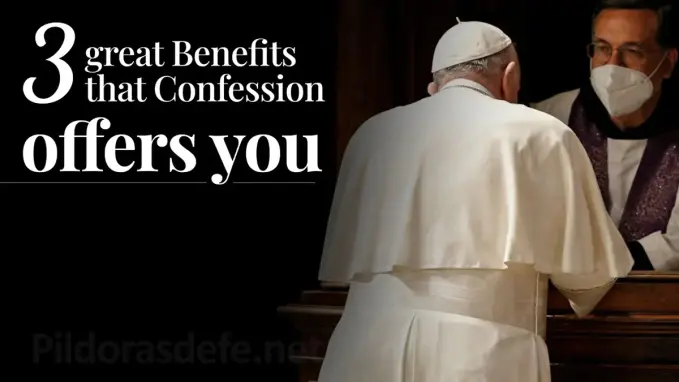
In one of his prayer intentions, Pope Francis invited the faithful to return to confession. He has reminded us that when we go to confession, we go to be healed, to have our souls cured.
The Sacrament of Confession, also called the Sacrament of Reconciliation or Penance, is the beautiful means by which we are reconciled with God, with ourselves, and with our brothers and sisters. A wise spiritual discipline is to make a good confession every month. Some saints, such as Padre Pio of Pietrelcina, recommended weekly confession. We never want any sin, however small, to weaken our friendship with the Lord. Saint Paul reminds us:
“God, who is rich in mercy, because of the great love he had for us, even when we were dead in our transgressions, brought us to life with Christ.” (Ephesians 2:4)
4 surprising facts about the sacrament of confession
1. The confessor who read souls
St. Padre Pio possessed a remarkable gift during confession. Countless penitents testified that he knew their hidden sins before they spoke them, revealing forgotten faults with gentleness and leading them to profound conversion. This charism, carefully documented during his canonization process, reveals how God can work through his ministers to bring souls face to face with truth and mercy.
2. Sixteen hours in the confessional
St. John Vianney, the Curé of Ars, often heard confessions for sixteen to eighteen hours each day. Pilgrims traveled great distances to kneel before him, and many left not only spiritually renewed but also freed from long-standing burdens. His life shows the extraordinary fruit that flows when a priest pours himself out in this sacrament of mercy.
3. Chains broken by absolution
Scripture and Church history record cases where sincere confession brought deliverance from spiritual oppression and deep-seated addictions. Just as Jesus freed the Gerasene demoniac, the words of absolution spoken in Christ’s name still break invisible bonds. Many faithful today testify that long-standing inner torments lost their power after a humble and complete confession.
4. Healing that reaches body and soul
The Church has always taught that unrepented sin can affect the whole person. Spiritual directors and saints have witnessed situations in which physical symptoms linked to hidden guilt or unconfessed sin eased or disappeared after absolution. While not every illness stems from personal sin, the grace of reconciliation frequently restores peace to both heart and body.
A prayer for the grace of a good confession
O Lord Jesus Christ, physician of souls and bodies, you instituted the Sacrament of Reconciliation so that we might return to the Father’s embrace.
Send your Holy Spirit upon me now. Grant me the grace to examine my conscience with honesty and courage, to see my sins in your light without despair, and to approach the confessional with a heart truly sorry. Through the ministry of your priest, speak your words of absolution over my life.
Cleanse me from every stain, break every chain that still binds me, and fill me with the peace that only you can give. Strengthen me to walk in newness of life, avoiding the occasions of sin and growing each day in your love. May this sacrament become for me a fountain of healing, freedom, and joy. I ask this through your most holy name.
Amen. 🙌
The quiet joy of coming home
At the heart of every confession lies a homecoming. We return not as strangers but as beloved children who have been missed. The Father does not wait with folded arms; he runs to meet us, just as he ran to the prodigal son. Each time we hear the words of absolution, heaven itself rejoices. Saint Paul assures us that God is rich in mercy and brings us to life with Christ even when we were dead in sin. This sacrament is never a punishment. It is the embrace that restores dignity, the kiss that heals every wound, and the feast that celebrates our return. May we never grow tired of accepting such extravagant love.
Step into the light of mercy today
The same Christ who breathed the Spirit upon the apostles still breathes peace into every contrite heart.
There is no sin too great, no burden too heavy, and no distance too far for the mercy that flows from this sacrament. Come home. Your Father is waiting.
There is no weight the Sacrament of Confession cannot lift and no darkness it cannot pierce with light. When was the last time you allowed yourself to be completely known and completely set free?
❓ FAQ: Frequently Asked Questions About the Sacrament of Confession
A good preparation begins with a prayerful examination of conscience. Place your life before the light of God’s Word, especially the ten commandments and the beatitudes. Ask the Holy Spirit to show you where you have failed in love toward God and neighbor. The Catechism teaches that this examination, made in the light of Scripture, disposes the heart for true repentance and joyful reconciliation (CCC 1454). Take time, be honest, and trust that God already knows and loves you.
Any sin you forget in good faith is still forgiven. The sacrament forgives all sins of which you are truly sorry, even those you do not remember. After confession, if a forgotten sin comes to mind, simply mention it at your next confession. God’s mercy is not limited by our memory. What matters most is a sincere heart that desires to be completely reconciled with him.
Christ himself gave the apostles the authority to forgive sins in his name (John 20:21-23). While private prayer is essential, the sacrament of confession is the ordinary means he established for the forgiveness of serious sins and for reconciliation with the Church. The Catechism states that those conscious of grave sin must receive sacramental absolution before receiving Holy Communion. This is not a burden but a gift that brings the certainty of forgiveness through the ministry of the Church.
The Church encourages frequent confession as a means of spiritual growth. Many saints, including Padre Pio and Saint John Paul II, went weekly. A good rhythm for most people is monthly, or whenever one is aware of serious sin. Regular confession helps us stay close to the Lord, grow in self-knowledge, and receive the grace to overcome recurring faults. It is a gift, not an obligation to be feared
Only baptized Catholics in good standing may receive the sacrament of confession validly. However, anyone may speak with a priest for spiritual guidance or to explore the faith. If a non-Catholic is preparing to enter the Church through the Rite of Christian Initiation, the sacrament becomes available after baptism and confirmation. The Church’s doors are always open for conversation and prayer, even when the full sacrament is not yet possible.
 Venezuelan, faithful husband and father of a family. Electronic engineer and missionary of the faith. Committed to the proclamation of the Gospel. Solid believer that there are always new beginnings. Whoever has God has nothing to stop him.
Useful Resources
Walking in Faith

Discover how to protect your mental and spiritual health with these effective Catholic strategies to prevent depression, leaning entirely on God's daily grace
Walking in Faith
Whoever receives the Brown Scapular commits to the Carmelite spirituality. Discover nine essential things you need to know about this powerful sacramental
Walking in Faith

Spiritual therapy offers a profound path to heal depression: Discover three essential Catholic steps to restore your mental health and find lasting peace today
Walking in Faith
Experience the miraculous healing anointing of the Sacred Heart of Jesus through this prayer: Discover how His infinite mercy can heal and transform your life.
Walking in Faith
Discover the 12 promises of the Sacred Heart of Jesus: Learn how these divine blessings of mercy, love, and protection can transform your family and life today
Walking in Faith