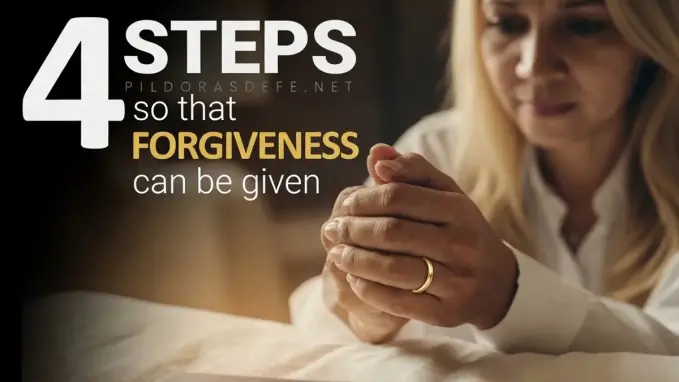
Discover the four essential steps to achieve true forgiveness and heal your broken heart today: Learn how releasing past wounds brings you lasting divine peace
We have all been profoundly wounded at some point, carrying the weight of betrayal without knowing how to process that pain healthily. True forgiveness has become a monumental struggle for many today. Most people desperately yearn to live a life overflowing with grace, completely free from the toxic chains of bitterness, yet they remain unsure of how to achieve this. If we want to follow the definitive steps to achieve true forgiveness, we must be intentional and courageous. We must understand that forgiving is never about pretending the offense did not occur, nor is it about excusing the transgressor from their responsibility; rather, it is about unshackling our own soul to experience the immense peace God promises.
Achieving true forgiveness
Now, to understand how true forgiveness can occur, it would be beneficial to ask ourselves a couple of questions first:
- Does forgiving mean pretending the offense never happened?
- Does it mean the other person is completely removed from the conflict?
This is an extremely important topic that helps us build healthier relationships. Did you know there is a biological basis for this? Forgiveness is not just a religious concept; it is a vital necessity. Science has shown that chronic resentment keeps the body in a permanent state of "fight or flight," raising blood pressure and weakening the immune system. Therefore, learning the steps to achieve true forgiveness is literally medicine for your body and your spirit.
4 steps to achieve the forgiveness we so deeply seek
Below, I will explain 4 steps that must occur for true forgiveness to take place.
If you apply these measures to your own areas of anger or pain, you will make a world of difference by freeing yourself and guiding your soul toward fulfillment (it is not necessary to follow them in this exact order).
For true forgiveness to be realized, we explain the 4 fundamental pillars so that inner reconciliation can take place. Applying these measures to your own areas of anger or pain will achieve a world of difference, liberating you and guiding you toward wholeness and the profound love that God desires for you.
1. Choose to heal instead of seeking revenge
My friend Derek Elam was shot to death when he was twenty years old, while working behind the counter at a music store. Diana, Derek's mother, responded to this tragedy with an incredible amount of grace and faith.
After Derek's killer was caught and convicted, instead of allowing bitterness and rage to steal her joy, she decided to pray for the murderer to extend grace in the hope that this young man would come to know forgiveness through Christ. And even though he will spend the rest of his life in prison for his crime, through faith in Christ, he could live in freedom, even while serving his sentence in a prison cell, and thus could reunite with Derek in heaven as a brother in Christ and not as an enemy.
Diana's faith has not only given her peace but has touched the hearts and lives of many people around the world who are struggling to forgive.
When we have been treated unjustly, there will surely be consequences, just as there were in the case of Derek's killer. When there are consequences, we have to trust that God will take care of this part.
It is never our job to take revenge. Our job is to trust in God alone. He is the only judge. Our mission is to seek peace and healing.
God gives us His best even when we are at our worst and calls us to do the same with others.
Biblical quote about forgiveness:
"If possible, on your part, live at peace with all. Beloved, do not look for revenge but leave room for the wrath; for it is written, 'Vengeance is mine, I will repay, says the Lord.'" (Romans 12:18-19)

2. Do not keep a record of past wounds
In any relationship, we are all exposed to being hurt. When a loved one damages us with their words or actions, our natural instinct is to return that same damage, but instead of this, we must consciously choose to set aside that right to "make them pay," so that we can achieve our own healing and also cure the relationship with our neighbor.
Just as we have a natural tendency to collect offenses, we also face the temptation to keep score and use them to tip the scales in our favor.
True forgiveness forces us to tear up this "invisible record of offenses." Healing cannot occur if we are constantly remembering all past transgressions.
In a relationship where faults are tallied, everyone loses. In a relationship where forgiveness is chosen, everyone wins. It has been said that holding resentment is like drinking poison, and then waiting for the other person to die! Do not fall into the trap of keeping score of offenses.
Biblical quote about forgiveness:
"Then Peter approaching asked him, 'Lord, if my brother sins against me, how often must I forgive him? As many as seven times?' Jesus answered, 'I say to you, not seven times but seventy-seven times.'" (Matthew 18:21-22)
Jesus is not saying that we can stop forgiving after exactly 70x7 = 490 offenses, but rather, He is using hyperbole to remind us that we should never keep a record in the first place.
3. Forgiveness and trust are two very different things
When forgiving becomes a conflict, it is often because we have the false idea that forgiving someone obligates us to instantly trust them again. The truth is that forgiveness cannot be earned, it can only be given (that is called "grace"), but trust cannot be given, it can only be earned (that is called "common sense").
When someone hurts you, you must offer your forgiveness instantly, but you should grant your trust little by little.
Trust is not a requirement to forgive, but forgiveness is required to allow trust once again.
As the Catechism reminds us, forgiveness does not mean forgetting the offense or ignoring danger. Prudence requires us to protect our hearts and set healthy boundaries. St. Thomas Aquinas teaches that while we must always will the good of the other—the essence of charity—we are not obligated to immediately restore them to a position of intimate trust until true repentance and consistent change are demonstrated over time.
4. Accept the apology, even if it never comes
Some of us hold grudges against people who never ask us for an apology. Perhaps you feel some bitterness toward someone who has already passed away. You may never hear the words: "I am sorry. I was wrong. Please, forgive me."
Furthermore, you might never again hear from someone who ought to say these words to you; therefore, we have to find the faith to place these wrongs in God's hands so we can move forward seeking peace instead of bitterness. As C.S. Lewis says: "It is like crossing the monkey bars; you have to let go to move forward."
Saint Augustine profoundly noted that holding onto resentment is a poison that destroys our own soul. When we surrender our right to an apology, we align ourselves with Christ, who forgave his executioners without waiting for remorse. Embracing this divine perspective allows the Holy Spirit to heal our wounds, anchoring our peace in God's eternal love rather than the unpredictable actions of others.

4 surprising facts about the power of forgiveness
1. The physical impact on your actual heart
Clinical studies have revealed that the simple act of releasing anger lowers your heart rate and significantly reduces your risk of severe cardiovascular disease, functioning as a literal shield for your physical heart.
2. The profound ancient Aramaic meaning
In the original Aramaic language spoken by Jesus, the word used for forgive is "shbaq," which literally translates to "untie." Forgiving is fundamentally about untying yourself from the person who caused you suffering.
3. The unexpected boost to immunity
Medical experts have discovered that individuals who practice unconditional forgiveness exhibit stronger immune responses, proving that letting go of past transgressions directly fortifies your body's ability to fight off dangerous illnesses.
4. The supreme example of Pope John Paul II
Following his harrowing assassination attempt in 1981, Saint Pope John Paul II did not just forgive his attacker publicly; he visited Ali Agca in his prison cell, demonstrating that radical grace transcends all human logic.
Embracing the divine gift of total healing
Walking the path of true forgiveness is rarely easy, but it is the only road leading to authentic spiritual freedom. As we release our grievances, we create space for the Holy Spirit to dwell. The Catechism of the Catholic Church affirms that forgiveness is the high point of Christian prayer, and only hearts attuned to God's compassion receive true peace.
Let us choose grace over vengeance, allowing Christ's redeeming love to transform our deepest pain into a glorious testimony of resilience, steadfast faith, and unwavering hope.

Prayer for a liberated heart and perfect forgiveness
Beloved Lord Jesus, I come before You carrying the heavy burden of wounds that still ache and memories that cloud my peace.
I recognize that by my own human strength, it is impossible to let go of resentment. Therefore, I cry out for the anointing of Your Holy Spirit to perform the miracle of reconciliation within me.
I surrender to You those who have hurt me, renouncing all desire for revenge and leaving ultimate judgment in Your merciful hands.
Wash my mind with Your Precious Blood and heal my soul's scars, looking forward with hope. Teach me to forgive just as You do. Amen.
Experience the Transformative Power of Divine Mercy Today
Letting go of the past is not a sign of weakness, but the ultimate demonstration of spiritual strength and reliance on God's infinite grace.
Share this vital message of hope and healing with someone who desperately needs to experience the liberating light of true forgiveness.
Releasing the heavy chains of bitterness is the greatest gift you can give your own weary soul. Every time you choose to forgive, you are actively participating in God's redemptive love, allowing light to shatter the darkness. Are you finally ready to let go and let God heal your heart today?
❓ FAQ: Frequently Asked Questions About true forgiveness
No, forgiveness and trust are entirely different concepts. Forgiveness is freely given through grace, while trust must be earned through consistent actions over time. As the Catechism of the Catholic Church highlights, prudence requires us to establish healthy boundaries to protect our hearts while still willing the good of the person who offended us.
We must remember that forgiveness is an internal decision, not dependent on the offender's remorse. Saint Augustine wisely noted that resentment destroys the one who holds it. By surrendering our desire for an apology to God, we emulate Christ on the cross, who forgave His executioners before they ever truly recognized their grievous sins.
Remembering the offense does not mean you have failed to forgive. Healing is a gradual journey. Saint Thomas Aquinas reminds us that our feelings often lag behind the firm choices of our will. Every time the painful memory surfaces, use it as a prompt to actively surrender the situation to God's boundless mercy once more
Seeking justice is not inherently opposed to forgiveness, provided it is done without a spirit of vengeance. In Romans 12:19, Scripture says, "Vengeance is mine; I will repay, says the Lord." We can peacefully seek rightful consequences through proper authorities while totally releasing the poisonous desire to personally inflict pain or exact revenge on the offender.
Harboring deep resentment forces your body into a prolonged state of stress, triggering a fight-or-flight response that elevates blood pressure and weakens your immune system. Choosing to release bitterness is literally medicine for both your physical body and your eternal soul, allowing God’s restorative peace to flow through every single aspect of your daily life.
 Mexicano, psicoterapeuta, casado, padre de tres hijos; catequista y defensor de la vida intrauterina. Amar a Dios es mi tesoro escondido, tocar los corazones es mi vocación y evangelizar es mi deber
Recursos de Utilidad
Matrimonio y noviazgo

Existen innumerables opiniones erradas sobre la infidelidad conyugal: Descubre aquí la verdad de la Iglesia para sanar y proteger el amor de tu matrimonio
Familia

Descubre la diferencia entre tener confianza y ser amigos de tus hijos: Aprende a ejercer una autoridad firme, amorosa y cristiana y salvar el futuro de tu hogar
Matrimonio y noviazgo

No es lo mismo ser esposos que solo compañeros: Conoce las 7 ventajas del matrimonio frente a vivir juntos sin compromiso y protégelo con la bendición de Dios
Matrimonio y noviazgo

Conoce los 10 consejos más valiosos para lograr un noviazgo verdaderamente santo: Descubre hoy el inmenso valor de la dulce espera en una relación unida a Dios.
Familia

El conmovedor testimonio de una enfermera revela las cinco cosas que más lamentan las personas antes de morir. Descubre cómo cambiar tu vida hoy y vivir en paz
Matrimonio y noviazgo

Descubre 14 consejos efectivos para disminuir las discusiones en el matrimonio: Sana la convivencia, restaura la comunicación y recupera la paz en tu hogar
Familia

Descubre 7 consejos esenciales para superar una crisis económica en el matrimonio: Fortalece la unión familiar y protege el futuro de tus hijos hoy. 🌿
Vida y tendencias